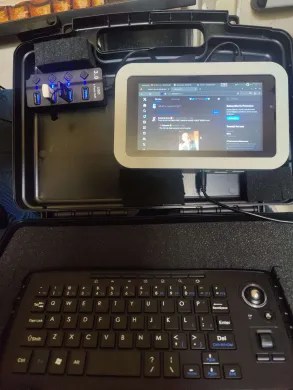
I’ve begun building something I’m calling a cyberdeck, although at the moment it’s a bit more of a DIY laptop. The main board is a Pine A64-LTS with their 1024×800 MIPI DSI touchscreen and the Playbox Enclosure. I have the WiFi/BT module that plugs into headers on the A64 but it works very poorly. It has great difficulty connecting to my home WiFi, and for some reason after every reboot the Bluetooth part disappears from rfkill completely. And so I have to use a cheap USB WiFi adapter instead.
Another major difficulty that this, along with most single-board computers of any significant power has is thermal management. The CPU on this thing gets hot even when just doing ordinary things like web browsing (the fact that most modern websites are actually major applications written against the browser does not help). I’d seen temperatures of 80°C before I added heatsinks, and the small, basic heatsinks used for old Raspberry Pis are nowhere near enough (they peak at around 78°C). My best bets have been with heatsinks intended for M.2 NVMe SSDs, but the thinner ones are also inadequate (75°C). A much larger heatsink I got looked promising (68°C) but then I couldn’t close the case with it. For now my best bet is a heatsink intended for CM4 moduIes from Waveshare (72°C). might even add a 5V fan if passive heatsinks really aren’t enough, but I’m waiting for another few SSD heatsinks that look promising.
The thing is powered by a set of three Panasonic NCR18650 batteries that are handled by a power management IC on the board. I was able to find some information on how the PMIC interfaces to the kernel, but I still haven’t figured out how to do a few things like set design maximum power for the batteries (the three NC18650s nominally should be 10,050 mAh total) and how to set up the LEDs to light when the batteries are, low power, etc.
That weird keyboard is driving me crazy though (seriously, a dedicated Ctrl-Alt-Delete?!), so I’m designing a custom one, which will be the subject of my next post.
 Stormwyrm: 蛟龍
Leave a comment