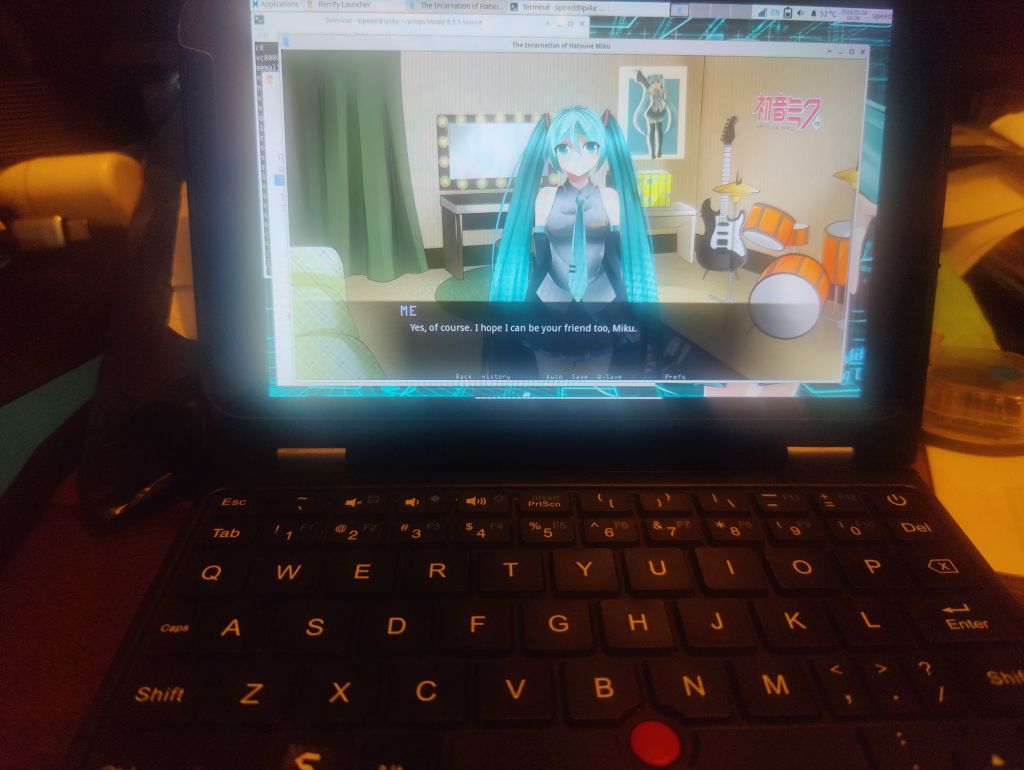
The LicheePi Console 4A that is perhaps the most powerful such device I have. Judging from the benchmarks I’ve been able to run on it, it seems to have about as much power as an AMD or Intel system from around 2008 to 2010, though its power is probably underutilised given how the software for it is still not as well-developed. There are perhaps improvements that can be made concerning heat dissipation, which is still a problem.
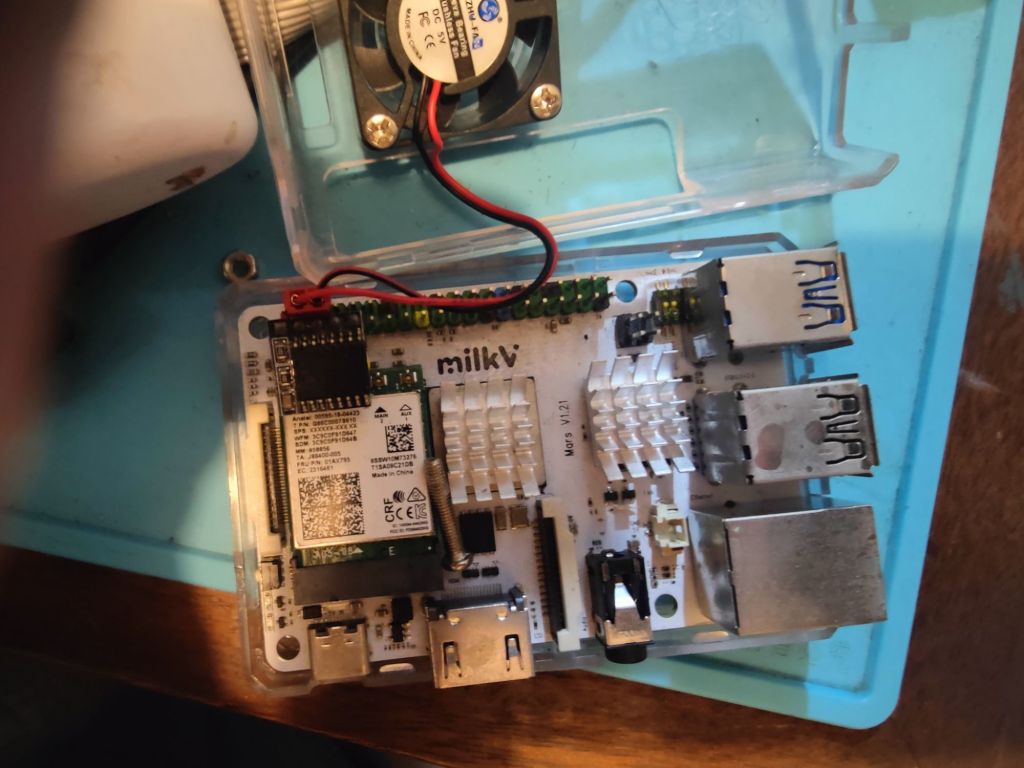
I also have a Milk-V Mars, which is in the Raspberry Pi form factor and seems to be roughly as powerful. I am having trouble with keeping the thing from overheating, given that the case I have found that best fits it (one originally intended for a Raspberry Pi 3), has the fan attachment in the wrong place to be able to cool the chips as effectively as possible. Those aluminium heatsinks are nowhere near enough to dissipate all the heat those chips produce when running at full power. I need better heatsinks and fans and probably a custom case designed for this if I’m going to use it seriously.
I’ve also got several Milk-V Duo boards, which were very cheap (about US$10 each) but are powerful enough to run a stripped-down Linux and I’m going to try bare metal programming them when I have the time. They’re only about the size of an Arduino Nano or a 40-pin DIP IC. I also have an Ox64 from Pine64 (slightly cheaper at US$8), which I have not yet gotten to work, and judging from the discussions on Pine64’s forums, folks have had some difficulty getting running as well. At the lowest end is the CH32v003 microcontroller, which is a 32-bit RISC-V core that seems to cost around 15¢ each, that I can probably use for projects that might need an Arduino.

Milk-V Duo 256 and CH32v003 dev board
The CH32v003 is probably the closest to bare metal that I can get as it’s a small microcontroller that I use a USB programmer to connect to special programming pins (on the header to the left) of the board. I suppose the system just starts up and begins executing whatever was written to its flash. I don’t think that a 15¢ microcontroller will do more. It seems there’s an effort to run Linux on this tiny system using a PSRAM chip and some other extra hardware, but this might be a long-term effort. I got some of the PSRAM chips that they mention and they are BGA, which makes them essentially impossible to use without a breakout board to solder them to, and soldering such things is… complicated. This might be an interesting exercise for the future. At any rate it looks like a platform that I can use to do simple embedded projects, like for the controller for a revision of my custom keyboard / trackpoint, if it has enough GPIO pins to handle it.
The Milk-V Duo looks interesting as it’s several steps between the CH32v003 and the full-blown systems like the Milk-V Mars and LicheePi Console. I was able to hook up a serial console to one and watch the boot process. It uses OpenSBI just like the bigger systems and it might well be easier to work with. Certainly needs less power, and doesn’t need heat sinks. I can try to figure out how to flash images onto it at a very low level. These boards are also only $10 each so it won’t be too painful if I manage to brick one.
Virtualisation is nice, but it’s always more fun to have real silicon to work with.
 Stormwyrm: 蛟龍
Leave a comment